
DO YOUR D.U.T.Y
A HOMEOWNER'S GUIDE TO SEPTIC SYSTEM CARE
Your septic system is a partnership. You do your duty by taking care of it, and we'll do ours by providing honest, dependable service when you need us.
WHAT IS THE DO YOUR DUTY GUIDE?
SIMPLE STEPS HOMEOWNERS CAN TAKE TO KEEP THEIR SEPTIC SYSTEM RUNNING SMOOTHLY
Septic systems don't ask for much — but a little regular attention goes a long way toward avoiding backups, bad odors, and expensive repairs. That's what DUTY stands for.
DON'T DUMP ITEMS DOWN YOUR DRAIN
Your septic tank is designed to handle wastewater — not everything that disappears down your sink or toilet.
-
Skip "flushable" wipes, paper towels, and feminine hygiene products — they don't break down
-
Pour grease, oil, and fats in the trash, never the drain
-
Go easy on bleach and drain cleaners — they kill the good bacteria your tank relies on
-
Never flush medications, cotton swabs, cigarette butts, or cat litter
Septic tanks work because naturally occurring bacteria break down what enters them — anything that isn't biodegradable just piles up. Wipes (even ones labeled "flushable"), paper towels, feminine hygiene products, dental floss, and cat litter don't break down, and in enough volume they can clog the outlet baffle or the pipes leading to your drain field.
Grease and cooking oil solidify as they cool, narrowing pipes over time — let it cool and toss it in the trash instead. Go easy on bleach and chemical drain cleaners, too; used constantly and in volume, they throw off the bacterial balance your tank depends on. And garbage disposals deserve a mention — every use adds solid waste directly to the tank, which speeds up how often you'll need to pump.
UNDERSTAND YOUR SEPTIC SYSTEM
A septic system works hard every day, but most homeowners don't know much about what's buried in their yard.
-
Know where your tank and drain field are located
-
Know your tank size and roughly how old your system is
-
Keep records of past pumping, inspections, and repairs
-
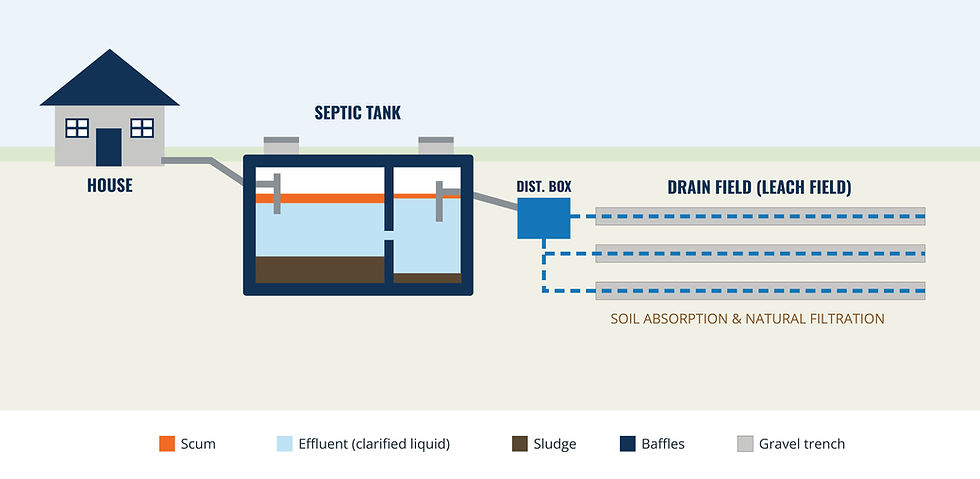
Check out our system diagram to understand how your system works
Knowing the basics protects you from the mistakes that cause most failures. Start with location — where your tank and drain field sit, roughly how large the tank is, and how many bedrooms the system was sized for. It helps to know what type of system you have too: a standard gravity tank, a pump system, and an aerobic treatment unit all have different maintenance needs.
History matters just as much — a system that's decades old and has never been pumped is a very different situation than one on a regular schedule. Keep a simple folder with your permit, a system diagram, and your pumping dates, and ask us to mark the tank location if you don't already know it.
TREAT YOUR SEPTIC SYSTEM WELL
Your septic system is built to last when it's treated properly.
-
Conserve water — spread out laundry loads and fix leaky fixtures
-
Keep vehicles and heavy equipment off the tank and drain field
-
Plant grass — not trees or shrubs — near your drain field
-
Have your tank pumped every 3–5 years
A septic system is built around a pace: wastewater settles in the tank before clarified liquid moves to the drain field. Push too much water through too fast — several loads of laundry back-to-back, a running toilet left unfixed — and the tank doesn't get time to separate solids properly, a problem called hydraulic overload.
Protecting the drain field matters just as much. Vehicles and heavy equipment can compact the soil or crack pipes, and tree and shrub roots naturally grow toward moisture and can infiltrate lines — grass is genuinely the best thing to plant there. Keep gutters and sump pump discharge directed away from the field too, since saturated soil can't filter effluent as well. None of this replaces pumping every 3–5 years, and septic additives aren't a substitute for it — most do nothing, and some can actually hurt your system.
YOU CAN CALL US WHEN DUTY CALLS
Don't wait until a small warning sign becomes a major problem.
-
Schedule a professional inspection at the first sign of trouble
-
24/7 emergency service (except Sunday mornings)
-
Licensed, insured, and IOWPA members
-
Honest, upfront service across northern Indiana
Even a well-maintained system benefits from a professional look now and then. Baffle condition, sludge and scum buildup, and pipe integrity aren't visible from the surface — catching a small issue at a routine visit beats discovering a failed system through a backup in the house.
That's the other half of the partnership: we're licensed and insured, IOWPA members, and focused on honest assessments rather than upselling — and we know the soil and systems here in northern Indiana because it's where we live and work. Since septic emergencies don't wait for convenient timing, we offer 24/7 emergency service, except Sunday mornings.
HOW YOUR SEPTIC SYSTEM WORKS
WHAT'S UNDER THE GROUND?
Most homeowners never see their septic system in action — it works quietly underground every day. Here's what's really happening beneath your yard.
Wastewater leaves your home through one main line and flows into the septic tank.
Inside the tank, solids settle to the bottom as sludge, grease and oil float to the top as scum, and relatively clear effluent sits in the middle.
Baffles at the inlet and outlet keep solids and scum inside the tank while letting only the clarified effluent flow out.
Effluent flows to a distribution box, which splits it evenly among the drain field's pipes.
In the drain field, effluent trickles through gravel and is naturally filtered by the soil before reaching groundwater.
5
4
3
2
1
Pumping removes the sludge and scum before they build up enough to overflow into your drain field — it's the single most important thing you can do for your system.
SEPTIC MAINTENANCE CHECKLIST
Simple steps, taken regularly, can save you thousands in repair costs down the road.
Schedule tank pumping every 3–5 years
Conserve water and fix leaks promptly
Never flush wipes, paper towels, or hygiene products
Keep trees, vehicles, and structures off the drain field
Skip additives — they're no substitute for pumping
Keep a record of pumping and inspection dates
Spread laundry loads out through the week
Dispose of grease and cooking oil in the trash
Direct downspouts and sump pumps away from the drain field
Call a professional at the first warning sign
WARNING SIGNS YOUR SEPTIC SYSTEM IS FAILING
Catching a problem early is almost always cheaper and easier than fixing it later. Watch for these signs.
SLOW DRAINS
Sinks, tubs, or toilets draining slowly — especially more than one fixture at once.
STANDING WATER
Soggy or pooling water over the tank or drain field, even in dry weather.
GURGLING PIPES
Unusual gurgling sounds when water runs or toilets flush.
UNUSUALLY GREEN GRASS
A noticeably greener, lusher patch of lawn over the drain field can signal a leak.
SEWAGE ODER
Foul smells indoors, or near your tank or drain field outside.
BACKUPS OR ALARMS
Wastewater backing up into drains, or a pump system alarm sounding.